Released!
PHP 8.1 is a major update of the PHP language.
It contains many new features, including enums, readonly properties, first-class callable syntax, fibers, intersection types, performance improvements and more.
Enumerations
Use an enum instead of a set of constants to get validation out of the box.
Readonly Properties
Readonly properties cannot be changed after initialization, i.e. after a value is assigned to them.
They are a great way to model value objects and data-transfer objects.
class BlogData
{
    private Status $status;

    public function __construct(Status $status)
    {
        $this->status = $status;
    }

    public function getStatus(): Status
    {
        return $this->status;
    }
}First-class Callable Syntax
It is now possible to get a reference to any function – this is called first-class callable syntax.
New in initializers
Objects can now be used as default parameter values, static variables, and global constants, as well as in attribute arguments.
This effectively makes it possible to use nested attributes.
class Service
{
    private Logger $logger;

    public function __construct(
        ?Logger $logger = null,
    ) {
        $this->logger = $logger ?? new NullLogger();
    }
}class Service
{
private Logger $logger;
public function __construct(
Logger $logger = new NullLogger(),
) {
$this->logger = $logger;
}
}class User
{
/**
* @Assert\All({
* @Assert\NotNull,
* @Assert\Length(min=5)
* })
*/
public string $name = '';
}class User
{
#[\Assert\All(
new \Assert\NotNull,
new \Assert\Length(min: 5))
]
public string $name = '';
}Pure Intersection Types
Use intersection types when a value needs to satisfy multiple type constraints at the same time.
It is not currently possible to mix intersection and union types together such as A&B|C.
function count_and_iterate(Iterator $value) {
    if (!($value instanceof Countable)) {
        throw new TypeError('value must be Countable');
    }

    foreach ($value as $val) {
        echo $val;
    }

    count($value);
}Never return type
A function or method declared with the never type indicates that it will not return a value and will either throw an exception or end the script’s execution with a call of die(), exit(), trigger_error(), or something similar.
function redirect(string $uri) {
    header('Location: ' . $uri);
    exit();
}

function redirectToLoginPage() {
    redirect('/login');
    echo 'Hello'; // <- dead code
}Final class constants
It is possible to declare final class constants, so that they cannot be overridden in child classes.
Explicit Octal numeral notation
It is now possible to write octal numbers with the explicit 0o prefix.
Fibers
Fibers are primitives for implementing lightweight cooperative concurrency. They are a means of creating code blocks that can be paused and resumed like Generators, but from anywhere in the stack. Fibers themselves don't magically provide concurrency, there still needs to be an event loop. However, they allow blocking and non-blocking implementations to share the same API.
Fibers allow getting rid of the boilerplate code previously seen with Promise::then() or Generator based coroutines. Libraries will generally build further abstractions around Fibers, so there's no need to interact with them directly.
$httpClient->request('https://example.com/')
        ->then(function (Response $response) {
            return $response->getBody()->buffer();
        })
        ->then(function (string $responseBody) {
            print json_decode($responseBody)['code'];
});Array unpacking support for string-keyed arrays
PHP supported unpacking inside arrays through the spread operator before, but only if the arrays had integer keys. Now it is possible to unpack arrays with string keys too.
Performance Improvements
25 consecutive runs, 250 requests (sec)
(less is better)
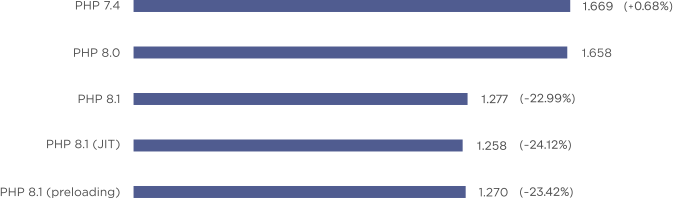
The result (relative to PHP 8.0):
- 23.0% Symfony Demo speedup
- 3.5% WordPress speedup
Performance related features in PHP 8.1:
- JIT backend for ARM64 (AArch64)
- Inheritance cache (avoid relinking classes in each request)
- Fast class name resolution (avoid lowercasing and hash lookup)
- timelib and ext/date performance improvements
- SPL file-system iterators improvements
- serialize/unserialize optimizations
- Some internal functions optimization (get_declared_classes(), explode(), strtr(), strnatcmp(), dechex())
- JIT improvements and fixes
New Classes, Interfaces, and Functions
- New
#[ReturnTypeWillChange]attribute. - New
fsyncandfdatasyncfunctions. - New
array_is_listfunction. - New Sodium XChaCha20 functions.
Deprecations and backward compatibility breaks
- Passing null to non-nullable internal function parameters is deprecated.
- Tentative return types in PHP built-in class methods
Serializableinterface deprecated.- HTML entity en/decode functions process single quotes and substitute by default.
$GLOBALSvariable restrictions.- MySQLi: Default error mode set to exceptions.
- Implicit incompatible float to int conversion is deprecated.
- finfo Extension:
file_inforesources migrated to existing finfo objects. - IMAP: imap resources migrated to
IMAP\Connectionclass objects. - FTP Extension: Connection resources migrated to
FTP\Connectionclass objects. - GD Extension: Font identifiers migrated to
GdFontclass objects. - LDAP: resources migrated to
LDAP\Connection,LDAP\Result, andLDAP\ResultEntryobjects. - PostgreSQL: resources migrated to
PgSql\Connection,PgSql\Result, andPgSql\Lobobjects. - Pspell: pspell, pspell config resources migrated to
PSpell\Dictionary,PSpell\Configclass objects.
